Budget Revision Time for a Short Academic Presentation
Turn a written draft into a timed speaking plan with measured rehearsal, transition space, and a clear cut order.
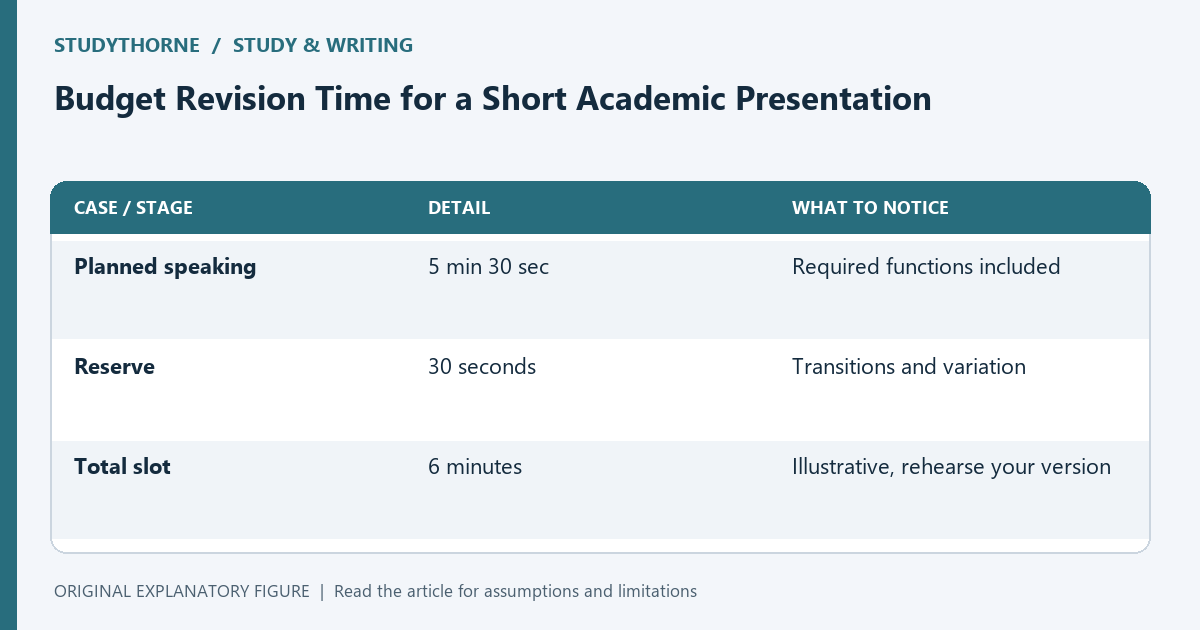
A short presentation is not simply an essay read aloud. A listener needs signposts, and your delivery includes pauses and slide transitions. This guide builds an illustrative six-minute talk from a written draft. It does not prescribe a universal speaking rate. Use your own rehearsal and the assignment’s timing rules to decide what fits.
Choose the listener’s takeaway
Write the one point you want the audience to understand at the end. Select the evidence needed to support it. A six-minute slot cannot necessarily contain every detail from a longer paper.
Keep the assignment requirements beside the takeaway. If the task requires a method explanation or limitations, reserve space for them. Do not remove required content simply because a dramatic opening or decorative slide consumes the available time.
Allocate functions before words
An illustrative plan reserves forty-five seconds for the question and claim, three minutes for explanation and evidence, one minute for limitations, and forty-five seconds for the conclusion. That uses five and a half minutes, leaving thirty seconds of reserve.
These are adjustable planning numbers. The reserve accommodates transitions and variation, not extra material automatically added at the end. If questions are included in the official slot, allocate them explicitly rather than assuming the whole slot is speaking time.
Measure a realistic rehearsal
Rehearse with the slides or notes you will use. Include deliberate pauses and transitions. Measure the complete run, not only the time spent speaking individual paragraphs. Note where you rush or need to explain an unfamiliar term.
The word counter’s reading-time estimate can be a rough starting point. Your actual delivery is the better planning evidence. A memorized fast run does not establish that a listener will understand the same material at that pace.
Create a cut order
Mark optional examples and secondary details that can be removed while preserving the main reasoning. Keep required definitions and the conclusion protected. If you exceed the slot, make a deliberate content cut before trying to speak substantially faster.
Write a short transition for each cut version so the argument still connects. Removing a slide can leave a reference such as “as the previous chart showed” that no longer makes sense. Check the spoken text after every structural change.
Finish with one full timed version
Rehearse the revised talk from beginning to end and record its duration. Check that the takeaway is still clear and that the final sentence is reached comfortably. Keep a brief note about the optional cut if the event runs differently.
Use the study timer for a complete rehearsal and the word counter for selected sections. The useful result is a measured, coherent version that fits the stated format, with assumptions about questions and timing visible rather than hidden inside a generic words-per-minute estimate.
| Case or stage | Detail | What to notice |
|---|---|---|
| Planned speaking | 5 min 30 sec | Required functions included |
| Reserve | 30 seconds | Transitions and variation |
| Total slot | 6 minutes | Illustrative, rehearse your version |