Calculate the Final Exam Score You Need Without Guessing
Work backward from a weighted course target, distinguish category averages from points, and check whether the target is attainable.
The score you need on a final exam depends on the grading structure, not just your current displayed average. A gradebook may exclude ungraded work, apply category weights, or use a points system. This walkthrough uses an illustrative weighted course and shows how to read the syllabus before calculating a target. Your instructor’s published rules remain the authority for the actual course.
Identify what the current average includes
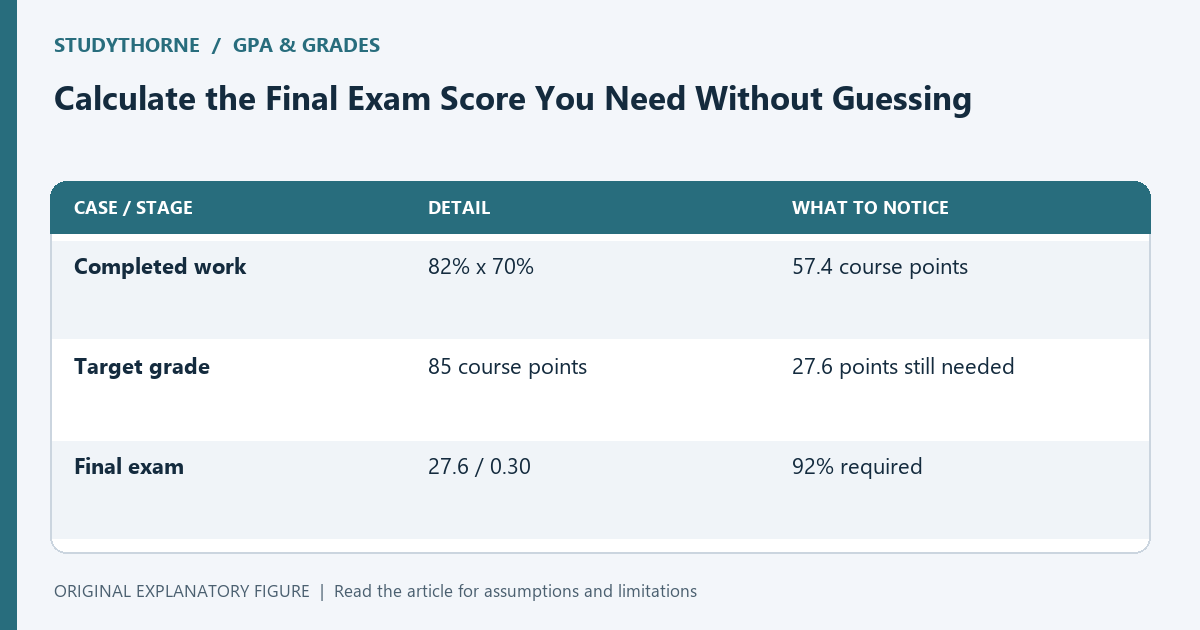
Suppose completed work counts for 70 percent of the final grade and the exam counts for 30 percent. An 82 percent average over completed work is not already 82 points toward the final total. It contributes 0.70 × 82 = 57.4 percentage points.
Check whether the gradebook displays an average over graded work only. A final exam currently shown as blank may be excluded rather than counted as zero. Record the remaining weight and any assignments still outstanding before treating the current average as fixed.
Solve backward from the desired total
Let F be the final-exam percentage and use 85 as the target course percentage. The equation is 57.4 + 0.30F = 85. Subtract 57.4, then divide by 0.30. The required exam result is 92 percent.
Keep the intermediate contribution visible. Jumping directly from “82 now” to “85 wanted” can hide the weight. If another assignment remains, include its separate contribution or set up several scenarios instead of assigning the whole gap to the exam.
Check feasibility before planning
For a target of 90 in the same example, F = (90 − 57.4) / 0.30, or approximately 108.7 percent. Without a documented extra-credit rule, that target exceeds a 100-percent exam maximum. The calculation identifies a constraint; it does not establish that your course offers a workaround.
Calculate the maximum possible course result: 57.4 + 30 = 87.4 percent. This lets you choose a realistic target and discuss any unclear grading rules with the instructor before spending time on an impossible assumption.
Handle points courses differently
If the course uses total points, collect earned points and all possible points, including the final. Do not apply a category-weight formula unless the syllabus actually uses it. For example, 410 points earned from 500 completed points plus a 200-point final creates a 700-point course total.
An 85-percent target means 595 total points, so the exam must supply 185 of its 200 points, or 92.5 percent. The numbers resemble the weighted example but come from a different model. Keep the grading model beside the arithmetic.
Turn the result into a study decision
Use the grade-average calculator to verify the arithmetic, then list the topics you can practice and the time available. A required score is a planning input, not a prediction of performance. Prioritize gaps revealed by practice questions rather than repeatedly recalculating the same target.
Check rounding and grade-boundary policies before assuming a displayed 84.95 becomes 85. Save the equation, assumptions, and syllabus reference. If the instructor changes a weight or adds an assignment, update the model instead of reusing an obsolete number.
| Case or stage | Detail | What to notice |
|---|---|---|
| Completed work | 82% x 70% | 57.4 course points |
| Target grade | 85 course points | 27.6 points still needed |
| Final exam | 27.6 / 0.30 | 92% required |