Keep a Source Ledger While Drafting an Essay
Track claims, page locations, quotation boundaries, and citation status before a reference list becomes hard to reconstruct.
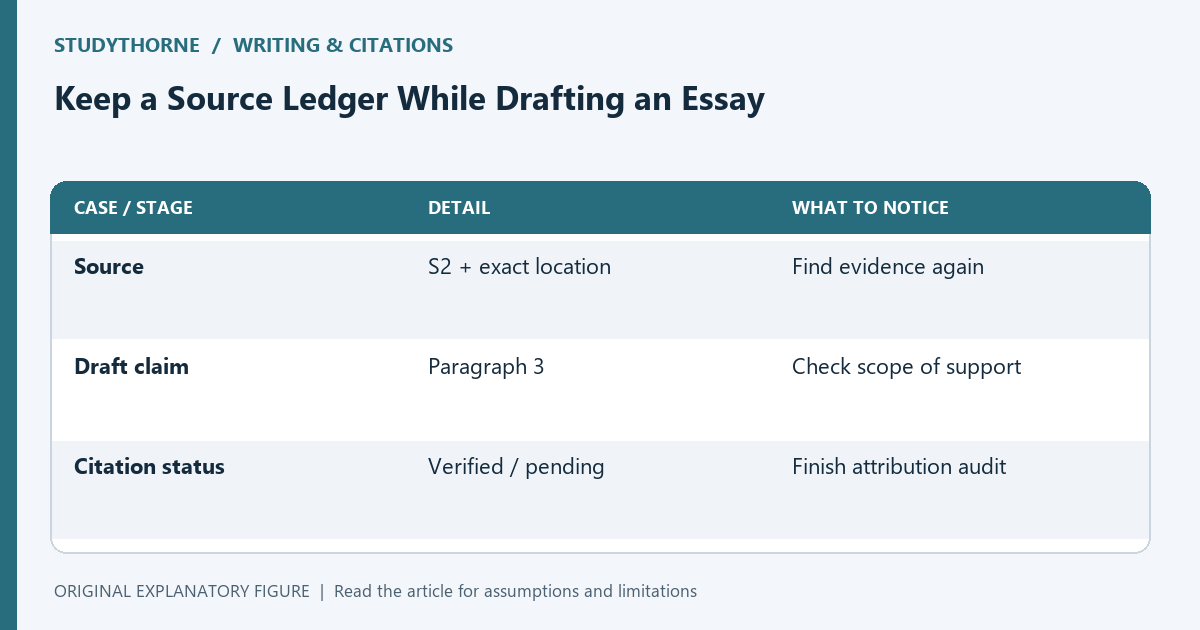
A reference list is easier to prepare when you know which source supports each claim. A source ledger is a small working table that connects your draft to the material you actually consulted. It is especially useful when several tabs discuss the same topic. This workflow does not prescribe a citation style: it preserves the information needed to apply the style your assignment requires.
Give each source a stable working label
Assign short labels such as S1, S2, and S3. Record the author or organization, title, date when available, URL or publication details, and the location you used. For a book or PDF, include the page number; for a webpage, record the section heading.
The label is a drafting aid, not the final in-text citation. Keep enough information to find the exact passage again. A bare homepage address or a search-results title will not reliably lead you back to the evidence.
Separate evidence from your interpretation
Make separate columns for the source’s point and your proposed claim. A source describing one classroom does not automatically support a statement about every school. Writing both sides exposes that leap before it enters the final essay.
For each planned paragraph, ask whether you are reporting the source, comparing sources, or drawing your own inference. Mark that role in the ledger. Your argument can go beyond a source, but the transition should be visible and defensible rather than disguised as a quoted fact.
Mark quotations immediately
Put copied words inside quotation marks in your notes and attach their source label and location immediately. Keep paraphrases in a separate field. Waiting until the final edit makes it harder to distinguish wording you wrote from wording you pasted.
A paraphrase still needs attribution when it uses another author’s idea. Changing a few words is not a substitute for understanding and rewriting the point. Close the source, explain the idea in your own sentence, then reopen it to check that you have preserved the meaning.
Audit claims in both directions
First walk through the draft and identify factual claims that need support. Connect each to a ledger entry or mark it for further research. Then walk through the ledger and check which sources are actually used. This catches both unsupported paragraphs and references left over from abandoned sections.
Do not fill a reference list merely to reach a target number of sources. If two entries duplicate the same evidence, decide whether both serve the argument. Your assignment may have source-type requirements, so review those separately.
Generate citations only after the record is complete
Use the citation tool to format a draft entry from the information you have verified. Compare it with your required style guide and assignment rules. A generator cannot tell whether a source supports your claim or whether the metadata you entered is correct.
Before submission, confirm that every in-text citation has the appropriate reference entry and that the final style is consistent. Keep the ledger as a private working record. It saves time when a teacher asks where a specific claim came from or when you revise the argument later.
| Case or stage | Detail | What to notice |
|---|---|---|
| Source | S2 + exact location | Find evidence again |
| Draft claim | Paragraph 3 | Check scope of support |
| Citation status | Verified / pending | Finish attribution audit |