Reverse Outline a Draft Before Cutting Its Word Count
Identify repeated paragraph jobs, missing reasoning, and weak transitions before trimming an essay sentence by sentence.
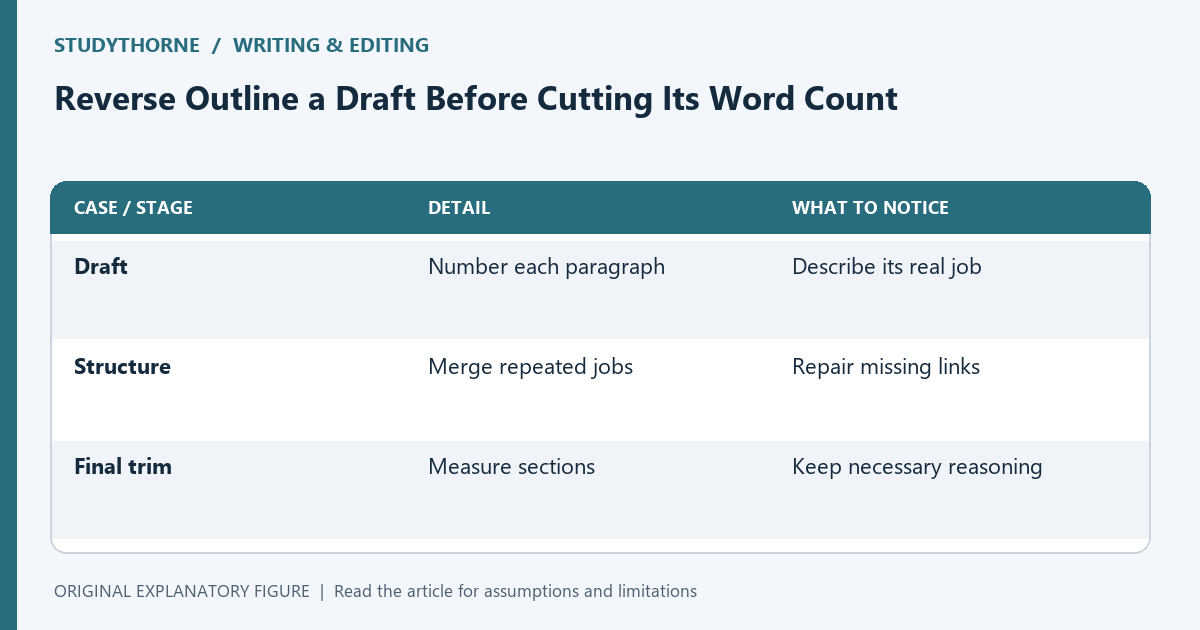
When an essay is over its limit, deleting adjectives may save a few words while leaving the argument tangled. A reverse outline starts with the draft you have and records what each paragraph actually does. It helps you choose structural cuts before line edits. The method is useful even when your draft is under the limit but feels repetitive or difficult to follow.
Describe each paragraph in one sentence
Number the paragraphs and write a short statement of each paragraph’s claim or job. Use what it actually says rather than what you intended it to say. A paragraph that cannot be summarized clearly may contain several competing jobs.
Add a second note naming the evidence it uses. “Explains why the intervention matters; uses the survey result” is more informative than “background.” Keep this outline outside the draft so you can compare the sequence without being distracted by polished wording.
Look for repeated jobs
Two paragraphs can repeat a claim even when their sentences differ. If paragraphs 2 and 4 both explain the same limitation, ask whether they should merge or whether one needs a distinct purpose. Preserve genuinely different evidence when it changes the argument.
Cutting repetition does not mean keeping only the first mention. A later paragraph may provide the clearer explanation. Move the strongest evidence into the paragraph that best serves the structure, then remove the duplicate setup rather than deleting isolated useful sentences.
Check the reasoning between claims
Read the one-sentence outline as a miniature argument. Does paragraph 3 follow from paragraph 2? Does the conclusion answer the question the introduction raised? Mark missing links before you start compressing the text.
An unexplained leap can require adding a sentence even while you are cutting elsewhere. Word-count editing should protect the reader’s ability to follow the reasoning. Remove repeated background to make room for the necessary explanation instead of treating every addition as a failure.
Allocate a word budget by function
For an illustrative 1,200-word assignment, you might reserve 150 for the introduction, 900 across the main argument, and 150 for the conclusion. Those are planning numbers, not a universal essay formula. Adjust them for the prompt and discipline.
If one background section takes half the draft, compare its contribution with the space it consumes. Use the word counter to measure selected sections. A section budget reveals where a structural edit can save substantially more than small stylistic cuts.
Finish with sentence-level edits
Once the paragraph jobs are distinct and ordered, shorten repeated setup phrases, remove claims the evidence does not support, and replace vague wording with direct wording. Check that each citation still attaches to the correct claim after moving sentences.
Rebuild the reverse outline from the revised draft rather than reusing the old one. The new outline should show a clear sequence with fewer repeated jobs. Finally, confirm what counts toward the assignment’s limit, because references, headings, and quotations may be treated differently by different instructors.
| Case or stage | Detail | What to notice |
|---|---|---|
| Draft | Number each paragraph | Describe its real job |
| Structure | Merge repeated jobs | Repair missing links |
| Final trim | Measure sections | Keep necessary reasoning |