Use an Error Log to Prepare for a Problem-Solving Exam
Classify practice mistakes, choose a repair exercise, and retest without confusing remembered answers with understanding.
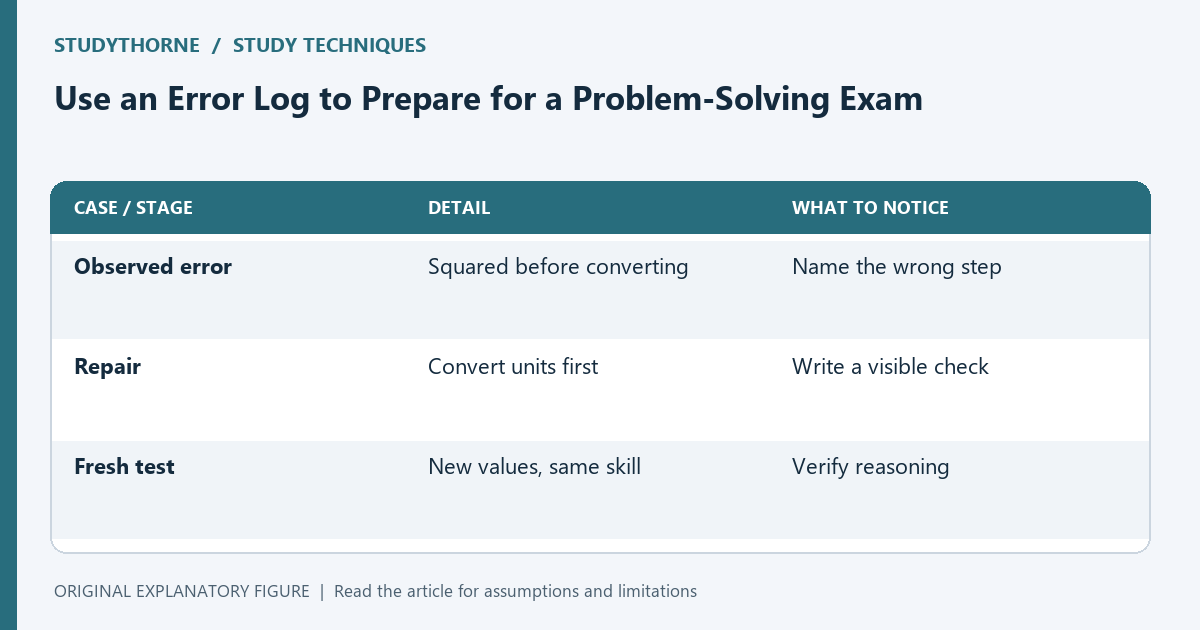
A practice score says how many questions you got right; an error log can show what to practice next. The useful log is brief and specific. It connects a missed problem to a cause you can investigate and a new question that tests the repair. This guide fits calculation-heavy subjects, but the same structure can help with grammar or logic exercises.
Log the decision that went wrong
After checking a solution, describe the earliest incorrect step. “Careless” is too broad to guide practice. “Converted centimeters to meters after squaring” names a concrete mistake. Keep the problem number and topic so you can find the original question.
Use a small set of provisional categories: concept, method selection, execution, or time pressure. They are working labels rather than a diagnosis. A missed sign might be execution in one problem and a misunderstanding of direction in another. Explain the actual step before assigning the label.
Write a repair action
For a concept gap, explain the rule with a simple example and check it against the course material. For method selection, compare two problems that look similar but require different approaches. For execution, add a visible intermediate line or unit check at the step you skipped.
Do not turn the repair column into “study harder.” It should tell you what to do in your next short session. One focused exercise is easier to evaluate than rereading an entire chapter with no specific question.
Retest with a changed problem
Solving the same question immediately after seeing its answer can reflect memory of the solution. Choose a fresh problem with the same underlying skill and a different surface. In a unit conversion, change both the value and the unit direction.
Work without the answer open, then check the result and reasoning. If the same error returns, revise the proposed cause. If the answer is right but the reasoning is uncertain, mark the item for another check rather than treating one correct response as complete mastery.
Prioritize patterns over individual scores
After several practice sets, count recurring causes. Three method-selection mistakes in one topic may deserve attention before a one-off arithmetic slip elsewhere. Also consider how much the topic matters to the exam and whether you have materials to practice it.
Keep the log manageable by grouping repeated errors under one repair plan. You do not need a long diary of every wrong answer. A concise summary preserves attention for practice and makes repeated problems visible without overwhelming the page.
Use time constraints as a separate test
First check whether you can solve a problem correctly without a tight timer. Then try a realistic timed set. If accuracy drops only under timing, practice choosing a stopping point and moving on, subject to the exam’s rules.
Use the study timer to bound a session and reserve time to review the log. Record whether the repair worked on a fresh question. The outcome you want is an observable change in the next attempt, such as a correct unit conversion with every step written, rather than a motivational judgment about your ability.
| Case or stage | Detail | What to notice |
|---|---|---|
| Observed error | Squared before converting | Name the wrong step |
| Repair | Convert units first | Write a visible check |
| Fresh test | New values, same skill | Verify reasoning |