Make Practice Questions From a Lecture Without Copying Its Sentences
Convert lecture ideas into answerable questions, include application prompts, and check the answers against your course material.
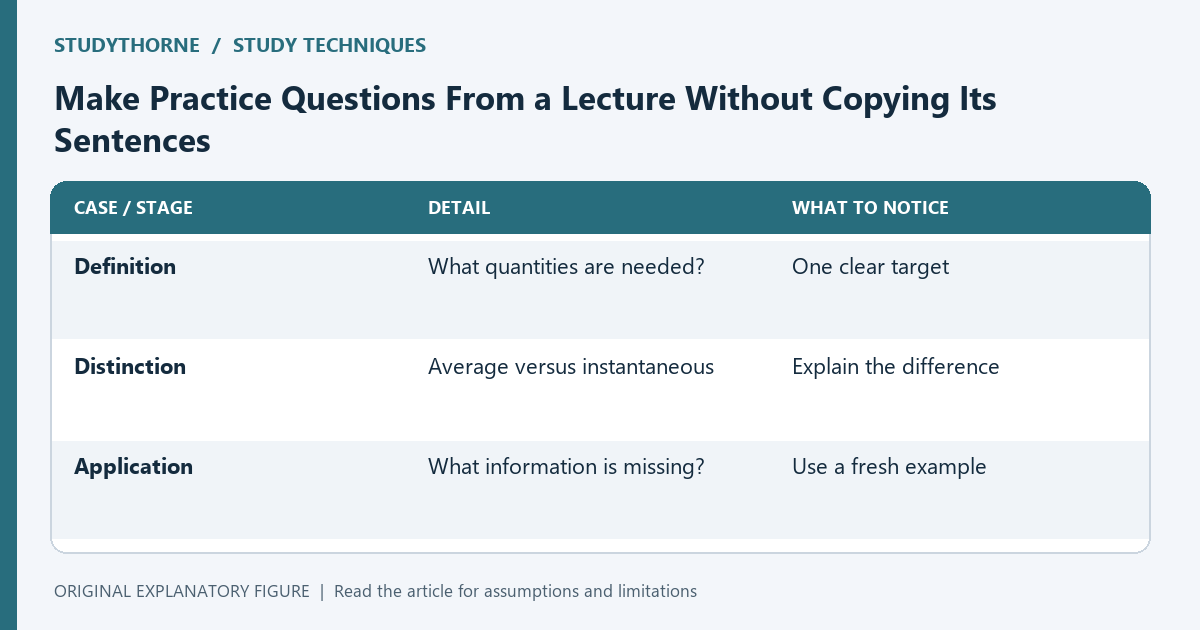
A page of copied lecture statements is not automatically a useful practice set. Questions need a clear target and an answer you can check. This guide turns a small section of notes into definition, distinction, and application prompts. It is a practical study workflow, not a claim that a particular number of questions or review interval is optimal for every learner.
Choose one concept boundary
Pick a small topic, such as the difference between average speed and instantaneous speed. Write what the lecture actually taught and where the explanation appears. Avoid creating questions about material the course has not introduced yet.
Keep the source location with the answer key. When a question exposes confusion, you need to return to the relevant explanation quickly. A broad label such as chapter three is less useful than a slide, page, or section reference.
Write questions with one main target
Ask “What quantities are needed to calculate average speed?” rather than “Explain everything about motion.” A narrow prompt lets you judge whether the answer addresses the intended concept. Keep wording understandable without the original slide open.
Do not preserve the lecture sentence structure so closely that its phrasing becomes a clue. The aim is to retrieve the idea, not finish a familiar sentence. Write a concise answer in your own words, then verify it against the material.
Add a distinction prompt
Ask how the concept differs from a related one. In the example, compare average speed over an interval with a speed at an instant. State which difference the answer must include.
A distinction question can reveal a misunderstanding hidden by a memorized definition. If both answers remain vague, revise the prompt or revisit the source. Do not count the question as successful simply because you can repeat its keywords.
Add an application prompt
Create a new small example with changed values or circumstances. For instance, ask what information is missing from a journey description before average speed can be calculated. Keep the example within the course’s scope.
Check the answer key carefully. A self-written problem can be ambiguous or under-specified unintentionally. Mark those problems for revision rather than blaming yourself for failing a question whose assumptions were never stated.
Test and repair the set
Answer the questions without the notes open, then compare with the key. Record whether a miss came from the concept, the wording, or a flawed key. Update the set before using it again.
Use the study timer for a bounded attempt and the error-log guide for recurring mistakes. Keep only prompts that test a meaningful idea. A smaller checked set is easier to review than a large collection of copied sentences that merely feels comprehensive.
| Case or stage | Detail | What to notice |
|---|---|---|
| Definition | What quantities are needed? | One clear target |
| Distinction | Average versus instantaneous | Explain the difference |
| Application | What information is missing? | Use a fresh example |