Map an Assignment Rubric to a Revision Checklist
Turn broad grading criteria into paragraph-level checks without treating a checklist as a guarantee of a grade.
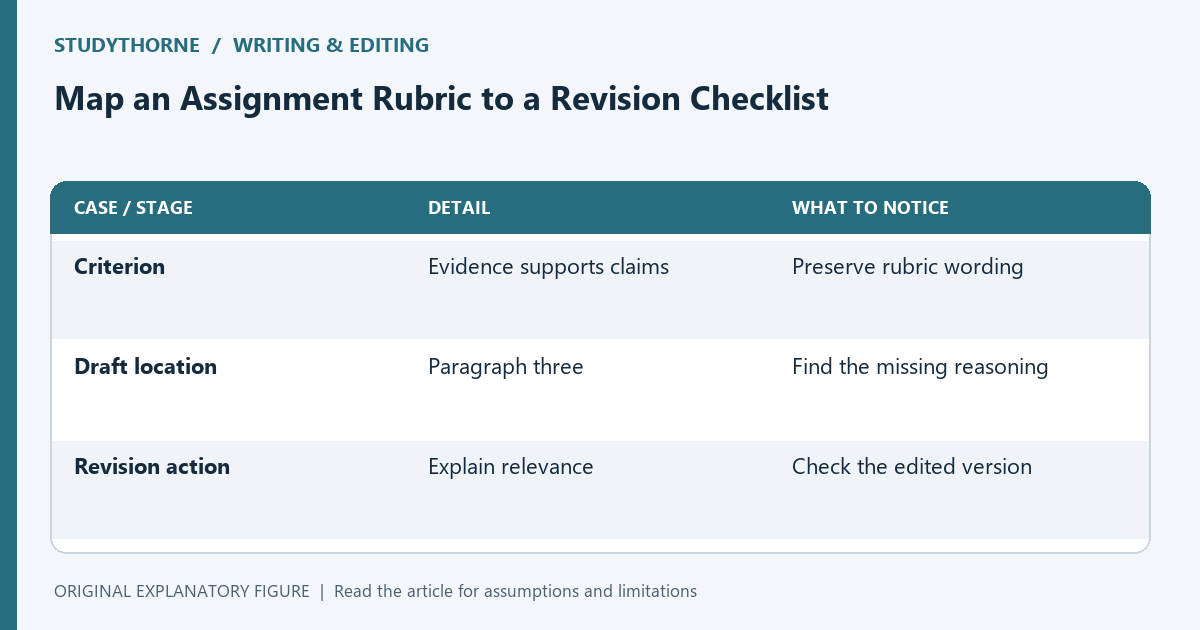
A rubric can describe analysis, evidence, and organization while leaving you unsure what to revise first. A working checklist translates those criteria into questions about your actual draft. This guide uses a short argumentative essay as an example. The checklist supports revision; it cannot replace the instructor’s judgment or promise that a particular set of checks earns a specific grade.
Copy the criteria accurately
Keep the rubric’s actual wording and any weight or priority it states. Separate required elements from descriptions of quality. A requirement for three sources is different from a criterion asking for thoughtful use of evidence.
Do not reduce the rubric to the easiest items to count. Record unclear phrases as questions for the instructor. If you invent an interpretation, label it as your working interpretation rather than presenting it as an official grading rule.
Write an observable question for each criterion
For evidence, ask whether each main claim has relevant support and whether the paragraph explains how that support bears on the claim. For organization, ask whether the paragraph order makes the reasoning followable.
Avoid checks such as “analysis is excellent,” which simply repeat the rubric. A useful question directs you to a place in the text. The answer may still require judgment, but it should identify what you need to inspect.
Locate the evidence in the draft
Add paragraph numbers or section names beside each check. If the draft has no paragraph performing the required job, mark the gap. If several paragraphs do the same job, inspect whether the repetition helps or consumes space.
For an illustrative essay, paragraph three may present evidence without explaining its relevance. The revision action is to add that reasoning or replace unsuitable evidence, not merely to insert another citation.
Choose structural repairs before polish
Prioritize a missing claim, unsupported reasoning, or a required section before small wording changes. A clean sentence cannot repair an argument that never answers the prompt. Keep sentence edits in a later pass.
Use the rubric’s weights when it provides them, but do not assume a weight is an exact measure of revision time. A low-weight requirement may still be mandatory. Write the chosen repair and its location so the next session begins concretely.
Run the checklist on the revised version
Check the actual edited draft rather than remembering what you intended to change. Confirm that moved sentences still have the correct citations and that a new paragraph does not repeat another section.
Use the word counter to inspect length after structural changes. Keep a short record of unresolved questions and review the assignment instructions separately. The outcome is a draft whose relationship to the rubric is visible, with judgment and uncertainties preserved rather than hidden behind completed boxes.
| Case or stage | Detail | What to notice |
|---|---|---|
| Criterion | Evidence supports claims | Preserve rubric wording |
| Draft location | Paragraph three | Find the missing reasoning |
| Revision action | Explain relevance | Check the edited version |