Plan a Group Essay With Paragraph Owners and One Final Editor
Assign argument responsibilities, agree on source records, and leave time for a whole-draft review.
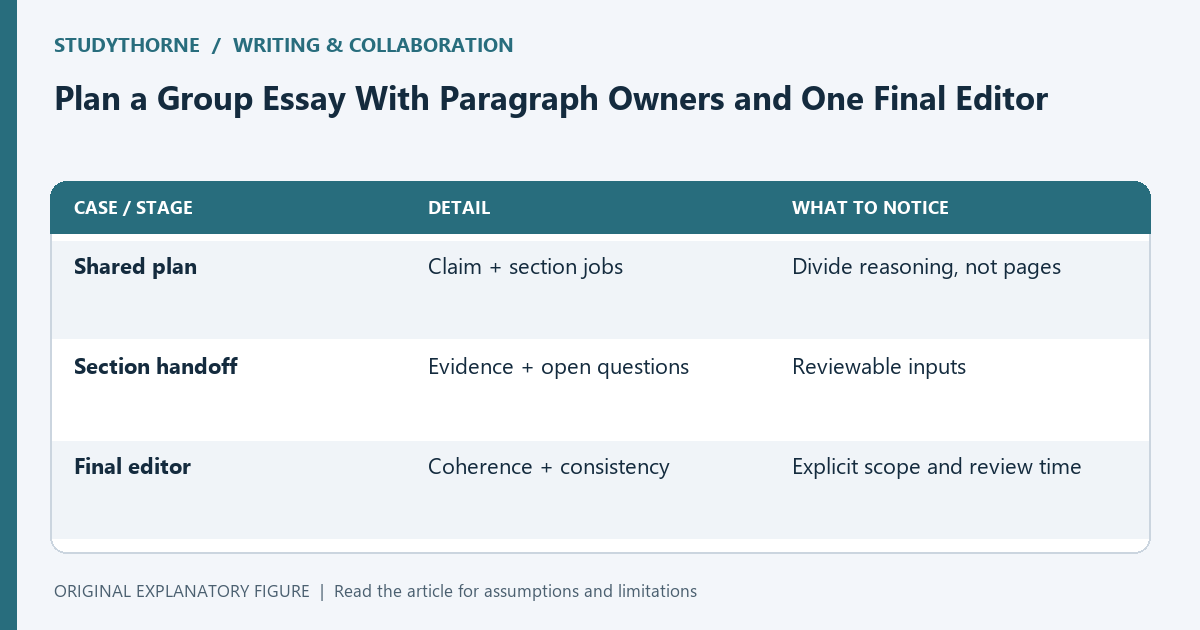
A group essay can contain good individual sections and still read like several unrelated papers. Paragraph ownership helps only when everyone shares the argument and the final review has an owner. This guide organizes a small collaborative draft. It does not send messages or assign work for you; it provides a concrete structure the group can agree to use.
Agree on the argument before dividing pages
Write the central question, working claim, and intended section sequence together. Then assign responsibilities by argument job rather than giving everyone an arbitrary number of pages. Background, evidence, counterargument, and synthesis require different work.
Keep the plan provisional enough to change when the evidence changes. Each section owner should know how their claim connects to the next section. Without that connection, a page allocation can reward length while leaving gaps in the reasoning.
Define a reviewable section handoff
Ask each owner to deliver a section with a main claim, evidence locations, and open questions. Include citations in a shared working convention. A polished paragraph without traceable sources is harder to integrate than a rough but well-supported section.
Set an internal handoff time before the official deadline. Choose it from the group’s actual availability. Do not describe it as agreed unless everyone has accepted it through your normal collaboration process.
Use one source ledger
Record which source supports which claim and who checked the metadata. Keep quotations clearly marked from the moment they enter the draft. This reduces the risk of losing attribution when one person moves another person’s sentences.
If two sections use the same source, inspect whether they make distinct points or repeat evidence. A common ledger lets the group find that overlap before the final editor has to reconstruct every contributor’s research.
Give the final editor an explicit scope
One editor can review transitions, terminology, duplicated setup, and citation consistency. That role should not become an unplanned obligation to redo everyone’s research or write missing sections at the last moment.
Reserve time for questions to return to section owners. Keep substantive changes visible for review. A single editor improves coherence when the group has supplied reviewable inputs and agreed on how final decisions are made.
Check the whole essay against the prompt
Run a reverse outline on the combined draft and compare it with the assignment. Verify that the conclusion follows from the evidence rather than simply combining individual endings. Check word-count rules after integration.
Use the word counter for section and total length, and the citation generator for verified metadata. The finished result should have one understandable argument and traceable contributions. A group process is successful when its handoffs support that result, not when every contributor writes exactly the same number of words.
| Case or stage | Detail | What to notice |
|---|---|---|
| Shared plan | Claim + section jobs | Divide reasoning, not pages |
| Section handoff | Evidence + open questions | Reviewable inputs |
| Final editor | Coherence + consistency | Explicit scope and review time |